Melville Vaughan
Killers of the Flower MoonMelville Vaughan is a biology professor and a grandson of W. W. Vaughan whose family’s accumulated records help the book’s narrator revisit his grandfather’s unsolved murder. Appearing alongside his cousin Martha Vaughan, Melville brings forward decades of family research and identifies H. G. Burt as a man who embezzled money from W. W. Vaughan’s estate. His role is not that of a witness to the killing or a professional investigator; it is that of a descendant who preserves evidence, helps recover a neglected lead, and connects family memory to an archival inquiry.
Identity and Family Connection
Melville is introduced at a meeting arranged by Martha, W. W. Vaughan’s granddaughter. She describes him as someone who knows a great deal about their grandfather. The two cousins meet the narrator in the lobby of the Skirvin Hotel, whose oil-boom splendor provides the setting for a conversation about the Vaughan family and the murder. Melville’s professional identity as a biology professor contrasts with the work he has brought to the meeting: a substantial private record assembled not for his career, but around a family killing that remained unresolved.
The book later acknowledges Martha and Melville together for shedding light on their grandfather. That recognition places Melville within a wider network of relatives and descendants who supplied information to the research. His contribution is specific: he helps make the family archive available and helps identify a name that sends the investigation in a new direction.
The Family Archive
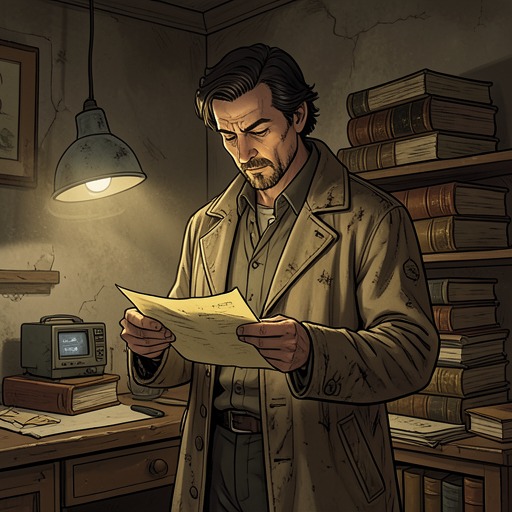
At the hotel, Melville sets two thick binders on the bar. Their contents document how the family had gathered material about W. W. Vaughan’s murder over many years. The binders contain faded newspaper clippings, including one headed “PAWHUSKA MAN’S NUDE BODY FOUND,” Vaughan’s death certificate, and a statement from an informant to the Bureau of Investigation. That statement reported that, shortly before his death, W. W. Vaughan had said he had collected enough evidence to put William K. Hale in the electric chair.
The binders do more than preserve an account of grief. They assemble different kinds of records—press coverage, an official document, and an informant’s account—without making them equivalent or resolving the uncertainties between them. Their condition and contents make the family’s sustained attention tangible: the murder had not disappeared simply because its investigation failed to establish a clear answer. Melville’s decision to bring this material to the meeting lets the narrator examine a body of evidence shaped by the family’s own long effort to keep the case in view.
The Burt Lead
The conversation turns from the materials about Hale to another possible line of inquiry. Martha recalls that a man embezzled money from W. W. Vaughan’s estate after his death and that W. W. Vaughan’s widow, Rosa, sued him in civil court. She cannot initially supply the man’s full name, remembering only that it was something like Burt. Melville identifies him as H. G. Burt and adds that Burt was a bank president.
The exchange offers a concrete lead, not proof that Burt killed W. W. Vaughan. The family’s account connects Burt to money taken after the death; it does not establish who carried out the murder or precisely how it happened. The narrator recognizes that the name may raise the family’s hopes and tells Martha and Melville that he will see what he can find. The distinction matters: Melville supplies a route for further research, while the evidence needed to assess that route must come from elsewhere.
That archival search later reveals that H. G. Burt was closely associated with William K. Hale, that an informant had described the two as having divided money obtained from George Bigheart, and that Burt had been guardian of Bigheart’s daughter. The narrator also finds evidence that Burt had taken money intended for W. W. Vaughan. These later findings deepen the significance of the name Melville supplied, but they do not turn the family’s lead into a conclusive account of Vaughan’s murder. The book preserves the difference between what the relatives knew, what the records disclose, and what remains uncertain.
Narrative Role and Limits
Melville’s appearance marks a meeting point between family-held knowledge and public records. The binders preserve the Vaughan family’s effort to document the murder; the exchange about Burt adds a name that the narrator can pursue in court and government files. The investigation then moves beyond what Melville can establish in conversation, testing the lead against records of guardianship, money, and associations among powerful men. His importance lies partly in that sequence: family memory does not end the inquiry, but it directs attention toward evidence that might otherwise remain overlooked.
The book does not present Melville as having solved the case or as knowing who killed his grandfather. Instead, it shows how a descendant’s careful preservation of documents and willingness to share a family lead can reopen an investigation while leaving its limits visible. Melville contributes an archive and a name; the eventual record remains incomplete. In a history crowded with missing testimony, uninvestigated deaths, and unresolved suspicions, his contribution helps make the difference between an absent answer and a question that can still be investigated.